
Animal Storage Cage/ Habitation Chamber is where the rodent test subjects are kept and cared for before they are used in various testing.
The center (CIBM3) houses an animal satellite facility exclusively for the CIBM3 users and is approved by the Institutional Animal Care and Use Committee of Rutgers University. The satellite facility is equipped with automatic 12:12hr light dark cycle and (air cycles - and add any other special things). In the current setting, the facility can house up to 60 animals (rats) for a period of 2 months (Refer to figure 19).
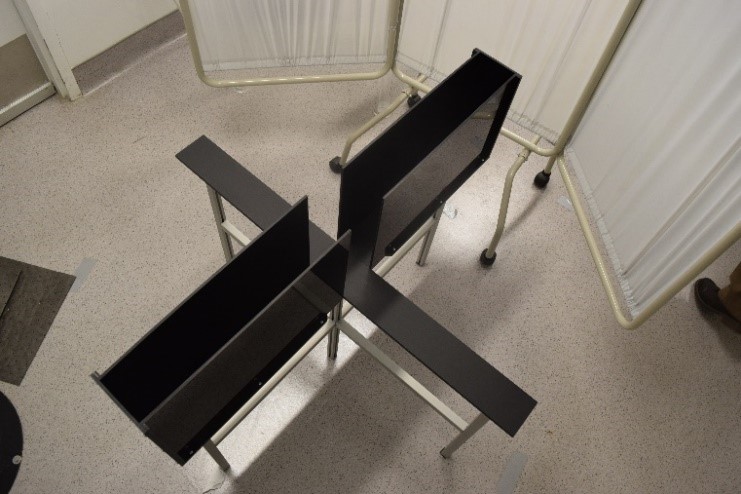
Elevated Plus Maze
The Elevated plus maze is another maze used to test anxiety levels in laboratory rodents. The rodent’s aversion to moving in the un-enclosed spaces is used to measure the anxiety levels of the rodent.

Elevated Zero Maze
The Elevated zero maze is used to asses anxiety-like behavior in rodents. Anxiety-related behavior is measured by the degree to which the rodent avoids the unenclosed areas of the maze
The Elevated Zero Maze (EZM) and Elevated plus maze (EPM) are used to text anxiety based on the general aversion of rodents to open spaces. The elevated zero maze (EZM) is an elevated circular runway with alternating open light areas and enclosed dark areas. The continuous nature of this apparatus eliminates the problem of the EPM in how to account for the animal's presence in the center area of the EPM. The test uses an elevated, plus-shaped (+) apparatus with two open and two enclosed arms. Anxiety indicated by an increase in the proportion of time spent in the closed spaces as opposed that spent in the open spaces.

The Morris Water Maze is a behavioral test used with rodents. The Morris Water Maze measures the subject spatial memory, movement control and cognitive mapping.
The Morris water maze is a behavioral tool used to study spatial learning and memory. The basic procedure for this task is that the rat is placed in a large circular pool and is required to find an invisible platform that allows it to escape the water by using various cues. The animal is given several rounds of training before the actual testing day. The escape latency, which is the time it takes to find the platform is noted. In normal animal, the escape latency improves with each training cycle. Hence, an extension of this latency suggests a cognitive decline or deficit in spatial learning/ memory.

The Rotarod is used in motor skills tests in rats such as evaluating balance, grip strength, and motor coordination.
The Center recognizes the diverse array of behavioral changes that may occur following brain injury. Hence, the center is fully equipped to perform assays to determine deficits in motor co-ordination, memory, anxiety and sleep. More specifically, the Rotarod (Make and model) is a performance test based on a rotating rod with forced motor activity being applied by the test animal (rat). The test measures parameters such as balance, grip strength and motor coordination of the subjects; especially in testing the effect of brain injury.

Biochemistry: site-directed mutagenesis of cyanobacterial circadian clock
EducationThird year doctoral student at NJIT
About MeI started the doctoral program in 2017 Fall, and I am going to continue my research in Dr. Yong-Ick Kim’s lab.
Contact Info
Biomechanics: Characterizing the dynamic changes in microglia after blast injuries
EducationThird year undergraduate Biology student in the Albert Dorman Honors College and College of Liberal Arts and Sciences at NJIT
7-Year Accelerated BS/MD Program with NJMS
About MeI joined the Center for Injury Biomechanics, Materials, and Medicine in the spring of 2018, with an Honors Summer Research Institute award to work on my project. Characterizing the dynamic changes in microglia will allow for the confirmation of whether or not microglial cells are activated in the brain after traumatic brain injury, an important step in confirming the role of microglia in neuroinflammation.
Contact Info
gv82@njit.edu

Research Area
Biomechanics: data analysis of EEG and video data collected in lab
Laboratory Research: collecting and staining of samples
Education
I am currently a Second-year undergraduate student at NJIT enrolled in the accelerated NJIT-NJMS BS/MD program. I am majoring in biomedical engineering and minoring in mathematical biology in the Albert Dorman Honors College and Newark College of Engineering at NJIT.
About Me
I joined the Center for Injury Biomechanics, Materials, and Medicine in the beginning of spring semester of 2018. I work on analyzing the effects of bTBI on epilepsy through rat models and am especially involved in the data analysis portion of the project, using EEGs and video recordings to formulate conclusions. I am currently working on investigating genetic predisposition to AD in exacerbating blast-induced brain injury, particularly in developing PTE, and will be pursuing this endeavor as a part of the 2018 Honors Summer Research Institute program at NJIT.
Contact Info

Biomechanics: I focus on analyzing microglial cells after blast induced traumatic brain injury. Blast injuries are known to lead to increased activation in microglial cells in the brain, which are thought to be involved in chronic neuroinflammation potentially leading to neurodegenerative conditions such as Alzheimer’s disease. Thus my research will focus on investigating how the initial pressure affects microglial cell activation.
Education
Third year undergraduate Biology student in the Albert Dorman Honors College and the College of Science and Liberal Arts at NJIT.
About Me
I am in the accelerated BS/MD program with New Jersey Medical School. I joined the Center for Injury Biomechanics, Materials, and Medicine in the spring semester of 2018. I received the Provost Summer Research Fellowship Award for the summer of 2018. I’m a part of the Honors Ambassadors program for the Honors College at NJIT. In addition, I am an EMT and I volunteer at the Saint Michael’s Medical Center.
Contact Info

Biomechanics: Characterizing and analyzing EEG changes after blast Injury to ascertain the relationship between epilepsy and traumatic brain injuries.
Education
Senior undergraduate Biology student in the Albert Dorman Honors College of Science and Liberal Arts.
About Me
I am currently in the accelerated BS/MD program. I have an interest in orthopedics and sports medicine. I joined the Center for Injury Biomechanics, Materials, and Medicine in the spring of 2018 and I am very excited to continue exploring the effects of blast waves on the brain.
Contact Info

I design, build, and test head surrogates to understand the load on its constituents under blunt and blast conditions. I also analyze the collected data. Some skills I use to accomplish this are CAD, 3D printing, machining, mold making and casting, high speed photography, and MATLAB coding.
EducationPhD Biomedical Engineering, NJIT (In progress)
MS Biomedical Engineering, NJIT
BS Biomedical Engineering, NJIT
About MeI worked with Dr Bryan Pfister and one of his graduate students (now alum) to complete my team’s undergraduate senior design project, developing a geometrically and “by feel” accurate viscoelastic brain model. Afterwards I was recruited into the Center for Injury Biomechanics, Materials, and Medicine.
Contact Infoasa58@njit.edu