Location
CHEN Building, Room 105
New Jersey Institute of Technology
Contact
Namas Chandra
Distinguished Professor, Bio-Medical Engineering
namas.chandra@njit.edu
973-596-6366
Monuel Aulov
Business Manager
monuel.m.aulov@njit.edu
973-596-6452
IBNR encompasses basic, applied and translational neuroscience research of faculty members from a number of NJIT departments in the Newark College of Engineering (NCE) and the College of Science and Liberal Arts (CSLA).
IBNR has two primary aims: to promote high-quality interdisciplinary research by developing synergies among research groups and to train graduate students and postdoctoral fellows in an interdisciplinary environment so that they can compete in the academic and industry markets.
Centers
Center for Injury Biomechanics, Materials, and Medicine
At the Center for Injury Biomechanics, Materials and Medicine (CIBM3) our goal is to help soldiers and citizens by understanding how blasts and blunt forces cause concussions and traumatic brain injuries.
Learn MoreCenter for Rehabilitation Robotics
This center is currently comprised of 8 projects applying robotics and virtual reality to improve the lives of individuals with disabilities.
Learn MoreKeck Center for Topological Dynamics
Its mission is to develop novel materials with advanced functionalities based on the topological principles celebrated by the 2016 Nobel awards in Physics, and to apply these discoveries to cancer research.
Learn More
Laboratories in the Institute of Brain and Neuroscience Research
|
Neurodevelopment, Injury and Repair Laboratory |
2nd Annual IBNR Graduate Student/Postdoctoral Research Showcase
Directors
Core Faculty
Bose, Amitabha
Professor
Professor
View ProfileBucher, Dirk
Professor
Professor
View ProfileDiekman, Casey
Professor
Professor
View ProfileFlammang, Brooke
Professor
Associate Professor
View ProfileFortune, Eric
Associate Professor
Associate Professor
View ProfileGarnier, Simon
Professor
Professor
View ProfileGolowasch, Jorge
Chair
Professor
View ProfileGrasman, Jonathan
Assistant Professor
Assistant Professor
View ProfileHaspel, Gal
Adjunct
View ProfileMacLaurin, James
Assistant Professor
Assistant Professor
View ProfileMatveev, Victor
Professor
Professor
View ProfilePal, Saikat
Associate Professor
Associate Professor
View ProfilePfister, Bryan
Chair
Chair
View ProfileRotstein, Horacio
Professor
Professor
View ProfileSahin, Mesut
Professor
Professor
View ProfileSeveri, Kristen
Assistant Professor
Assistant Professor
View ProfileSoares, Daphne
Associate Professor
Associate Professor
View Profile

The Rotarod is used in motor skills tests in rats such as evaluating balance, grip strength, and motor coordination.
The Center recognizes the diverse array of behavioral changes that may occur following brain injury. Hence, the center is fully equipped to perform assays to determine deficits in motor co-ordination, memory, anxiety and sleep. More specifically, the Rotarod (Make and model) is a performance test based on a rotating rod with forced motor activity being applied by the test animal (rat). The test measures parameters such as balance, grip strength and motor coordination of the subjects; especially in testing the effect of brain injury.
Newark College of Engineering
CIBM3
Graduate Students
Undergraduates
Laboratory of Neurovascular Neuroinflamation and Neurodegeneration
Graduate Students
-
Xioatang Ma
-
Yiming Cheng
-
Agnieszka Agas
-
Ziren Wang
-
Huilin Yang
Undergraduates
-
Ricardo Garcia
-
John Emmanuel Cruz Badiola
Center for Rehabilitaion Robotics
Graduate Students
-
Kevin Abbruzeesse
-
Madeline Corrigan
-
Peter Michael
-
Ala'a Al-Rashdan
-
Oyindamola Owoeye
-
Ashley Mont
-
Erick Nuñez
NESH Laboratory
Graduate Students
-
Min Zhang
-
Nima Alamatsaz
-
Dhara Rhana
Undergraduates
-
Jaasrini Vellore
-
Patrycia Puzio
Neural Prosthetics Laboratory
Graduate Students
-
Ali Ersen
-
Sinan Gok
-
Ferhat Erdogan
-
Ozan Cakmak
-
Ahmet Asan
College of Science and Liberal Arts
STG Laboratory
Graduate Students
-
Dalia Salloum
-
Xinping Li
-
David Fox
-
Jordan Storms
-
Elizabeth Cronin
-
Supriya Kannan
Undergraduates
-
Rebecca Deek
-
Rohit Premkumar
Fluid Locomotion Laboratory
Graduate Students
-
Callie Crawfod
-
Haley Amplo
-
Audrey Biondi
-
Zachary Robben
-
Tim Gassler
Neuroethology Laboratory
Graduate Students
-
Diana Pamela Rivera Parra
-
Andrea Roeser
Undergraduates
-
Monica Khattak
Swarm Laboratory
Graduate Students
-
Nicole Dykstra
-
Abid Haque
-
Subash Ray
-
Courtney Rockenbach
-
Maggie Wisniewska
-
Prit Zaveri
Undergraduates
-
Scott Bingham
-
Nicole Korzeniecki
-
Wajihah Memon
-
Amisha Naik
-
Oluwatobi Olarogba
-
Ana Pais
-
Ezekiel Sandor
-
Purva Shah
-
Zainah Shahsamand
Haspel Laboratory
Graduate Students
-
Lan Deng
-
Anmol Mittal
Undergraduates
-
Hardik Darji
-
Aditya Rawal
-
Assma Itani
Keck Center for Topological Dynamics
Graduate Students
-
Arooj Aslam
-
Kai Qian
-
Ssu-Ying Chen
-
Wenting Chen
Neuroecology of Unusual Animals
Graduate Students
-
Grace Capshaw
Dr. Yong-Ick Kim's Lab
Victor Matveev's Lab

The Morris Water Maze is a behavioral test used with rodents. The Morris Water Maze measures the subject spatial memory, movement control and cognitive mapping.
The Morris water maze is a behavioral tool used to study spatial learning and memory. The basic procedure for this task is that the rat is placed in a large circular pool and is required to find an invisible platform that allows it to escape the water by using various cues. The animal is given several rounds of training before the actual testing day. The escape latency, which is the time it takes to find the platform is noted. In normal animal, the escape latency improves with each training cycle. Hence, an extension of this latency suggests a cognitive decline or deficit in spatial learning/ memory.
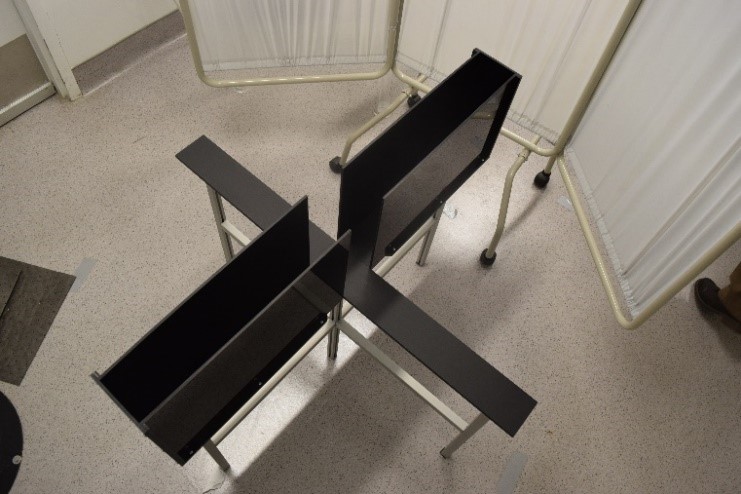
Elevated Plus Maze
The Elevated plus maze is another maze used to test anxiety levels in laboratory rodents. The rodent’s aversion to moving in the un-enclosed spaces is used to measure the anxiety levels of the rodent.

Elevated Zero Maze
The Elevated zero maze is used to asses anxiety-like behavior in rodents. Anxiety-related behavior is measured by the degree to which the rodent avoids the unenclosed areas of the maze
The Elevated Zero Maze (EZM) and Elevated plus maze (EPM) are used to text anxiety based on the general aversion of rodents to open spaces. The elevated zero maze (EZM) is an elevated circular runway with alternating open light areas and enclosed dark areas. The continuous nature of this apparatus eliminates the problem of the EPM in how to account for the animal's presence in the center area of the EPM. The test uses an elevated, plus-shaped (+) apparatus with two open and two enclosed arms. Anxiety indicated by an increase in the proportion of time spent in the closed spaces as opposed that spent in the open spaces.

Animal Storage Cage/ Habitation Chamber is where the rodent test subjects are kept and cared for before they are used in various testing.
The center (CIBM3) houses an animal satellite facility exclusively for the CIBM3 users and is approved by the Institutional Animal Care and Use Committee of Rutgers University. The satellite facility is equipped with automatic 12:12hr light dark cycle and (air cycles - and add any other special things). In the current setting, the facility can house up to 60 animals (rats) for a period of 2 months (Refer to figure 19).

Leica CM3050 Research Cryostat.
The Research Cryostat is primarily designed for cyrosectioning of delicate samples such as brain samples. The apparatus maintains a very low temperature making fine sectioning easier to do.